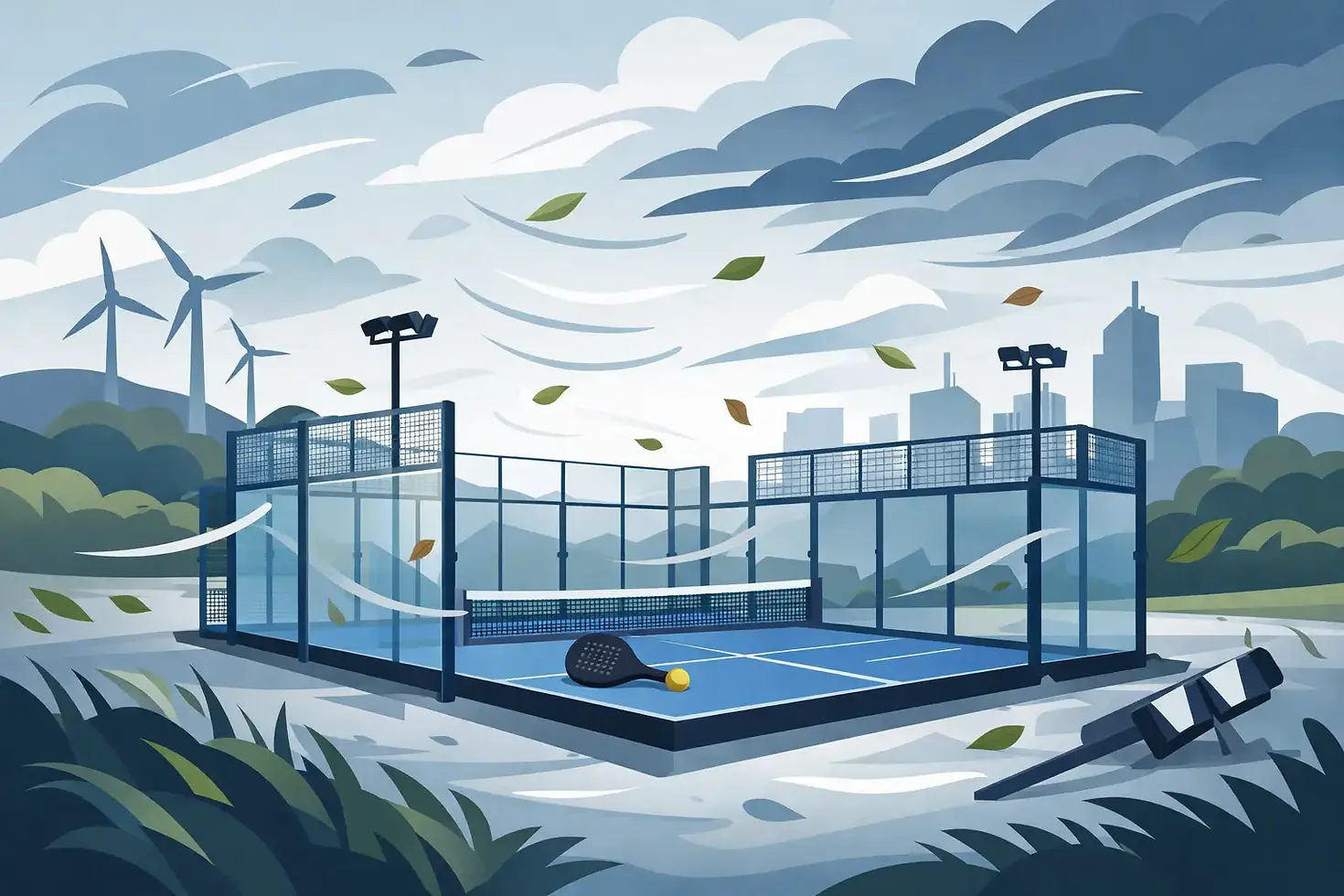
Can Padel Courts Withstand Wind in the UK?
A padel court is not simply a steel frame with glass around it. It is a loaded structure, fixed to the ground and designed to remain safe, playable and presentable through the weather conditions a UK site will face. So, can padel courts withstand wind? Yes - when the court, its foundations and its location have been properly assessed and engineered as one complete system.
For schools, leisure operators, clubs and landowners, that distinction matters. A court may look similar on a brochure, but wind performance is determined long before the glass is installed. It starts with the site survey, ground conditions, exposure and the quality of the base beneath the structure.
Can padel courts withstand wind? Yes, with the right build
A professionally specified outdoor padel court is designed to resist the forces created by wind acting on its steelwork, glass panels, mesh and lighting columns. The enclosure creates a large surface area, and wind pressure does not affect every site equally. An open coastal location, an elevated school field and a sheltered urban leisure site can all require different assumptions and details.
The strongest answer to wind resilience is not simply thicker steel. It is an engineered combination of structural steel, correctly specified glass, secure fixings, suitable foundations and careful installation. If one part is treated as an afterthought, the performance of the whole court can be compromised.
This is why a supply-only approach can create avoidable risk. The court structure must be matched to the actual ground it will sit on, rather than assumed to suit every plot in the same way. A turnkey construction partner can assess the site and coordinate the groundworks, drainage, concrete base, steelwork, glass, turf and lighting around a single design responsibility.
Wind loads begin with the site, not the court
Wind loading is influenced by more than a local weather forecast. Designers consider the location, altitude, surrounding terrain, exposure, nearby buildings and trees, and the height and orientation of the structure. A court set within a built-up sports complex may be partially sheltered. The same court on open land can be exposed to gusts from several directions.
In the UK, structural design should account for recognised wind actions and site conditions. This does not mean every court needs an unnecessarily heavy specification. It means the specification should be appropriate to the risk. Overbuilding adds cost without purpose; under-specifying may create a false economy that becomes evident in severe weather or during future inspections.
Orientation also deserves early attention. Positioning a court to manage prevailing winds can improve the playing experience as well as reduce direct exposure in some circumstances. It should be considered alongside access routes, neighbouring properties, lighting spill, drainage falls and available space for construction equipment. Moving a proposed court by a few metres during design can sometimes simplify several issues at once.
Why exposed sites need more scrutiny
Coastal, hilltop, rural and open-sided sites should not be ruled out for padel. They do, however, need a more detailed appraisal. Wind can accelerate around building corners, funnel through gaps and create local turbulence that is not obvious from a site plan.
At these locations, the project team may need to give particular consideration to structural calculations, foundation design, glass and mesh detailing, lighting-column specification and the sequencing of installation. A proper assessment protects the asset and gives decision-makers a clearer view of cost before construction begins.
Foundations are what keep the structure working as designed
The visible court gets the attention, but the base does much of the critical work. Wind forces acting on the enclosure are transferred through the steel frame and anchor points into the concrete foundation system. If foundations are poorly designed, inaccurately set out or installed on unsuitable ground, even high-quality steelwork cannot deliver its intended performance.
A padel court base must be level, stable and built with the correct drainage strategy. Precise levels matter for play, water management and the accurate installation of the glass and steel structure. The concrete must also provide dependable anchorage, with reinforcement and dimensions appropriate to the final court design and site conditions.
Ground investigation is particularly valuable where made ground, variable soils, slopes or poor drainage are present. It helps identify whether excavation, sub-base improvement or a different foundation approach is required. This work can feel invisible in the early stages, but it is where long-term reliability is won or lost.
Poor drainage introduces a separate but related problem. Standing water around foundations can affect the surrounding ground and reduce the quality of the playing environment. A properly planned drainage system directs water away from the court area, protects the surface and supports year-round use - a commercial advantage for facilities relying on bookings and membership value.
Steel, glass and fixings must work as a system
The steel structure provides the court’s primary frame. It needs suitable section sizes, protective finishes and accurately positioned connections so loads are distributed as intended. Galvanised and appropriately coated steel is especially relevant for outdoor UK installations, where repeated rain and moisture can challenge inferior finishes over time.
Glass is another key consideration. Padel courts use toughened safety glass engineered for its role within the enclosure. Panels are not simply decorative walls. They are part of a coordinated assembly that depends on correct supports, clamps, seals, tolerances and installation methods.
During strong gusts, a court will experience movement within its design limits. That does not automatically indicate a fault. What matters is that the frame, panels and fixings have been specified and installed to accommodate expected forces without loosening, cracking or transferring loads incorrectly. Precision during construction is therefore essential. Misaligned foundations, uneven levels or rushed glass installation can place stress where it was never intended.
Mesh sections also require attention. They are often perceived as less significant than glass, yet their posts, welds, panels and connections contribute to the enclosure’s overall response to wind. Quality control should cover the complete structure, not just the most visible components.
Lighting and ancillary equipment should not be overlooked
Floodlighting can make a padel court commercially viable beyond daylight hours, but columns and fittings are exposed elements. Their height means wind loading must be considered alongside the court enclosure, particularly on open sites. The foundations, brackets and cabling routes should be designed as part of the overall project rather than added late in the programme.
The same principle applies to gates, access control equipment, windscreens, signage and nearby fencing. Windscreens can improve comfort for players, but they also change how wind moves across a site and increase the load carried by their supporting structure. They should never be treated as a simple add-on without checking the supporting design.
For operators, there is a practical trade-off here. Additional features may improve customer experience and revenue potential, but each one should be specified with structural and maintenance implications in mind. A well-planned facility balances usability with long-term operating confidence.
Wind affects playability as well as structural safety
A court can be structurally sound and still feel unpleasant to play on if it is badly exposed. Padel is less affected by wind than some open-court sports because of its enclosure, but gusts can still influence lobs, serves and high balls. Players notice it, especially at venues where regular users expect a premium experience.
Siting, nearby landscaping and carefully designed perimeter treatments can help reduce the effect without creating maintenance or structural issues. The aim is not to remove every trace of wind - that is rarely realistic outdoors - but to avoid an unnecessarily exposed playing environment where the site offers better options.
This is also why early design conversations should include operational goals. A private court used occasionally has different expectations from a four-court commercial venue planned around peak-time occupancy, coaching, leagues and events. The greater the revenue reliance, the stronger the case for investing in proper site planning and construction from the outset.
Ongoing checks protect a long-term investment
Even a well-built court benefits from routine inspection. After severe weather, operators should check for loose fixings, damaged mesh, unusual movement, cracked glass, standing water and signs of coating damage or corrosion. Gates should close correctly, and the perimeter should remain secure.
These checks do not need to be complicated, but they should be consistent. Small issues are usually easier and less expensive to address before they affect availability, player safety or the appearance of the facility. A planned maintenance approach also supports the asset’s value over its working life.
CourtForge approaches padel construction as a complete build, from site assessment and drainage through to foundations, structure, surfacing, lighting and handover. That joined-up responsibility is particularly valuable where wind exposure, ground conditions or commercial operating requirements demand more than a standardised installation.
The right question is not whether a padel court can survive a windy day. It is whether the court has been designed for its particular site, built accurately from the ground up and maintained as the premium sporting asset it is intended to be. Get those fundamentals right, and wind becomes a managed design consideration rather than a reason to hold back a valuable facility investment.


Comments