Padel Court Lighting Requirements Explained
A padel court can look impressive in daylight and still underperform the moment the sun drops. Poor lighting changes ball tracking, creates safety issues around the glass and fencing, and makes a premium facility feel second-rate. That is why padel court lighting requirements matter well beyond simple visibility. For schools, clubs, leisure operators and landowners, lighting is part of the commercial performance of the court, not an afterthought.
If players struggle to judge lobs, corners or rebounds off the back glass, they notice immediately. If neighbours are affected by spill light, that becomes a planning problem. If fittings fail early because the installation was specified poorly, the maintenance bill follows. Good lighting has to work for the game, the site and the long-term operating cost.
What the padel court lighting requirements are trying to achieve
The basic aim is straightforward - players need to see the ball clearly from all parts of the court, at all heights and speeds, without glare. In practice, that means looking at average light levels, uniformity across the playing area, colour quality and the physical positioning of columns and luminaires.
A padel court is a compact space, but it is visually demanding. Players are reading a fast-moving ball against glass, mesh and changing backgrounds. Unlike a flat open playing field, padel also involves frequent upward tracking for lobs and overheads. Lighting therefore has to be even and controlled, not simply bright.
For most commercial and community installations in the UK, LED systems are now the standard choice. They offer better energy efficiency, lower maintenance demand and better control of beam angles than older lamp types. More importantly, a properly designed LED scheme can achieve the required playing quality without throwing unnecessary light beyond the court perimeter.
Recommended lux levels for padel courts
When discussing padel court lighting requirements, lux is usually the first figure people ask about. Lux measures the amount of light falling on a surface. It is useful, but it should never be treated as the only number that matters.
As a practical guide, recreational and general club play often sits around 200 lux. For regular training, busy pay-and-play use and a more professional user experience, 300 lux is a stronger benchmark. Competitive environments may require 500 lux or more, particularly where higher standards of play, filming or event use are expected.
The right level depends on who will use the court and how the site will operate. A school with evening curriculum and community lettings may not need the same specification as a premium sports club building a high-frequency commercial venue. Equally, under-lighting to save on upfront cost can be a false economy if it reduces evening bookings or creates player dissatisfaction.
Uniformity matters just as much as average lux. A court with bright patches and dim corners is harder to play on than one with slightly lower but consistent light. That is especially true in padel, where rebounds off side and back glass are central to the game. Players need confidence that the ball remains visible from serve to smash.
Why uniformity and glare control matter
Glare is one of the most common problems in poorly specified installations. If a player looks up for an overhead and catches direct light from a badly positioned fitting, the court may technically meet a lux target while still being difficult to use.
This is where lighting design needs to be sport-specific. Beam control, mounting height, tilt angle and optic selection all affect visual comfort. The goal is to illuminate the court surface and ball path while keeping harsh brightness out of players' direct sightlines.
Good glare control also improves the perceived quality of the venue. People may not describe it in technical terms, but they can tell when a court feels comfortable to play on. That has a direct effect on repeat bookings, member satisfaction and the reputation of the facility.
Column positions and mounting height
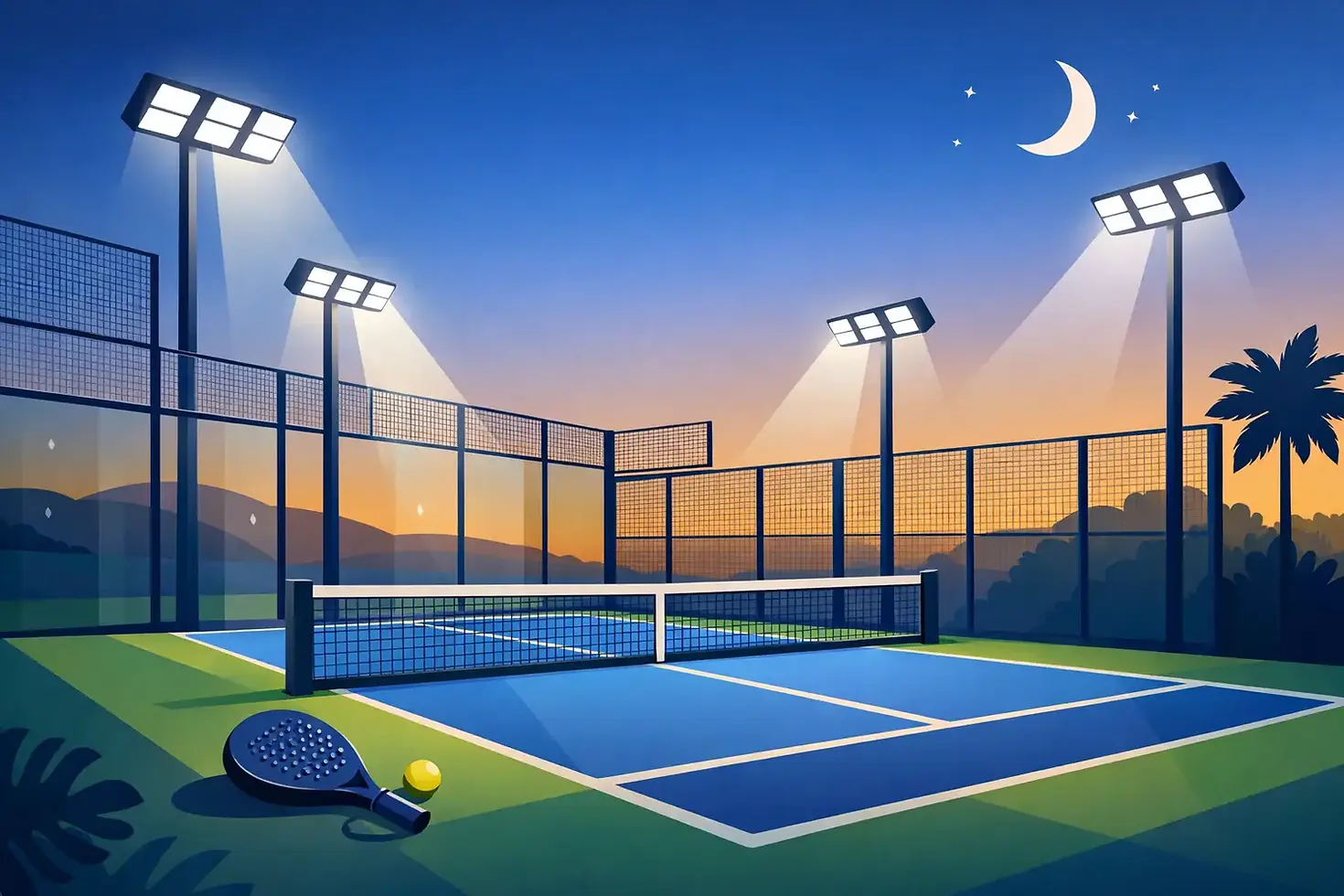
Most padel courts use four or six lighting columns, depending on the design brief, required light level and site constraints. The arrangement must work with the court structure, access points and surrounding circulation areas.
Column placement is not simply a matter of fitting lights where there is space. Put columns too low, and glare becomes more likely. Put them in the wrong position, and sections of the court can lose consistency. On some sites, the relationship between the court, boundary lines and nearby buildings also affects how the scheme should be set out.
A well-designed installation considers the whole build, not just the fittings. Foundations, drainage, cable routes and structural coordination all matter. If lighting is treated as a separate late-stage item, compromises usually follow. On a premium court, that is not where value is created.
Integrated design reduces problems later
This is one reason turnkey delivery matters. Lighting performs best when it is designed alongside the base, steelwork and overall site layout rather than bolted on at the end. CourtForge approaches it that way because proper levels, accurate setting out and coordinated installation all influence the finished result.
The lighting scheme should also reflect how the site will be used beyond the fence line. A hotel, for example, may prioritise guest experience and visual presentation. A council-led facility may focus heavily on durability, operating cost and planning sensitivity. A private club may want stronger evening performance to support peak-time revenue. The technical answer changes slightly because the commercial objective changes too.
Planning, light spill and neighbour impact
In the UK, lighting can become a planning issue very quickly if spill and upward light are not managed properly. This is especially relevant for courts near housing, schools, hotels or mixed-use sites.
Meeting padel court lighting requirements is not just about the players inside the enclosure. It is also about controlling the impact outside it. Modern LED optics help by directing light more precisely onto the playing area, but specification still needs care. A brighter fitting is not automatically better if much of the output is wasted beyond the court.
Hours of use may also influence planning conditions. If a court is intended for evening bookings, the design should support that operational model while remaining responsible to the surrounding environment. This is where detailed site assessment becomes important. Trees, boundaries, existing columns, neighbouring windows and local character all need consideration before a final scheme is agreed.
Colour temperature, colour rendering and player experience
Two lighting systems can produce similar lux readings and still deliver very different playing conditions. Colour rendering and colour temperature help explain why.
Good colour rendering makes the ball, lines, turf and surrounding structure easier to distinguish. That improves visual clarity during fast rallies. Colour temperature affects how the court looks and feels, and can also influence neighbour perception if the site is visible from outside.
A cooler white light may appear crisp and modern, but it needs to be balanced with comfort and planning sensitivity. A quality sports lighting specification should consider the viewing experience for players and spectators, not just raw output figures.
Running costs and maintenance are part of the specification
For any decision-maker investing in a court, the cheapest lighting package on day one is rarely the cheapest over ten years. Energy consumption, driver quality, corrosion resistance, mounting integrity and ease of maintenance all affect whole-life cost.
LED technology has improved operating efficiency significantly, but product quality still varies. A low-cost fitting that loses output too quickly or fails in a demanding outdoor environment can undermine the economics of the whole court. Downtime is not just an inconvenience. It means lost bookings, dissatisfied users and avoidable reactive maintenance.
That is why lighting should be judged as part of asset performance. If the court is expected to generate evening revenue, support member retention or add value to a hospitality or education site, reliability matters. A premium facility should be engineered for repeat use with minimal disruption.
The right lighting brief starts with the right questions
Before finalising a specification, it helps to define what success looks like. Is the court aimed at casual daytime use with occasional evening bookings, or is it expected to be a high-occupancy revenue generator? Will it serve juniors, club players, school groups or more advanced competition? Is the site sensitive from a planning perspective?
Those questions shape the correct solution. In many cases, a balanced design at around club standard is the right commercial choice. In others, a higher-spec scheme is justified because the business model depends on stronger evening utilisation and a more polished player experience.
The key point is simple. Padel court lighting requirements should be set by intended use, build quality and long-term return, not by guesswork or a race to trim capital cost.
A well-lit court earns its keep after dark. It supports safer play, stronger reviews, better utilisation and a more professional impression from the first booking onwards. If you are investing in a padel facility, treat lighting as part of the infrastructure that protects revenue, reputation and durability - because that is exactly what it is.


Comments