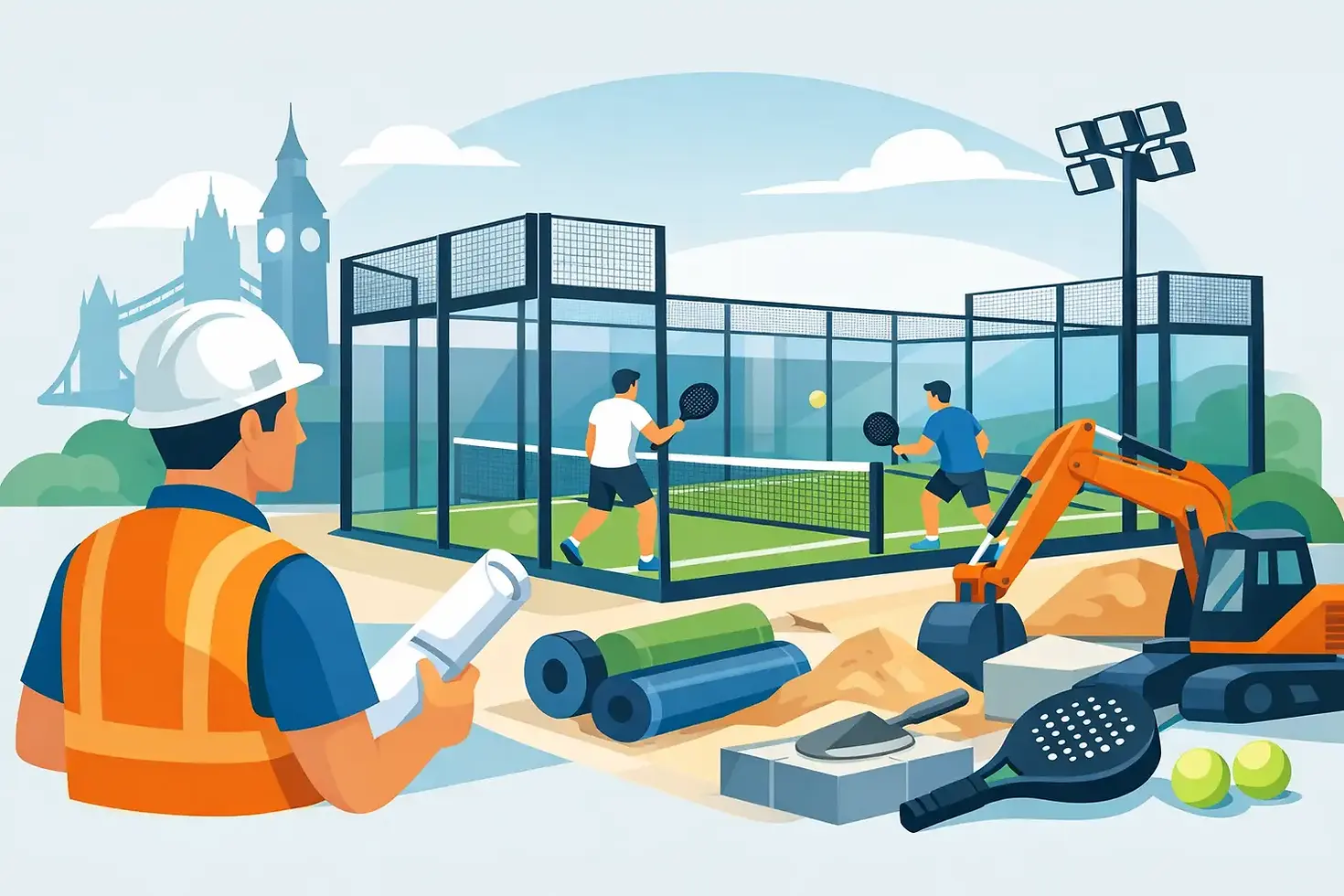
Padel Court Construction UK: What Matters
A padel court that looks good on handover but fails after one wet winter is not an asset. In padel court construction UK clients are not simply buying steel, glass and turf - they are investing in a facility that needs to perform day after day, generate bookings, and hold its presentation over time.
That is why the real question is not whether you can fit a court onto a spare section of land. It is whether that court will be built properly enough to protect revenue, reduce maintenance issues and stand up to heavy use in British conditions. For schools, clubs, hotels, leisure operators and councils, that distinction matters more than any brochure image.
Why padel court construction in the UK needs a different mindset
The UK is not a forgiving environment for sports construction. Rainfall, freeze-thaw cycles, variable ground conditions and tight planning considerations all place pressure on the build. A padel court is a precision structure, and small errors in levels, drainage or foundations can become expensive problems once the court is in use.
This is where buyers often make the wrong comparison. They look at headline build cost without examining what sits underneath it. On paper, two courts may appear similar. In practice, one may have been engineered with proper excavation depths, stable sub-base preparation, accurate levels and drainage that can cope with real weather. The other may not.
A cheaper initial build can become the more expensive option very quickly if standing water affects play, glass alignment drifts, or the surface wears unevenly because the base was not right from the start. The long-term value of the court comes from construction integrity, not from shaving cost out of the hidden stages.
What separates a good build from a risky one
The visible parts of a padel court get most of the attention. Clients notice the glass, the steelwork, the lighting and the artificial turf because those are the elements they see first. The performance of the court, however, depends just as much on what is below surface level.
Groundworks and drainage
Groundworks set the standard for everything that follows. Before any structure is installed, the site needs proper assessment, excavation and preparation. If levels are inaccurate or the formation is unstable, every later stage is compromised.
Drainage is equally critical. UK sites vary widely, and there is no single answer that suits every project. Some locations need careful management of existing falls, some require integrated drainage solutions, and some may need more significant enabling works because of poor ground conditions. What matters is that drainage is designed around the site rather than treated as an afterthought.
Foundations and base accuracy
Padel courts demand precision. The steel structure and glass panels rely on a base that is stable and accurately formed. Poor tolerances do not stay hidden for long. They show up in installation issues, surface inconsistency and premature wear.
A professionally built base gives the court its long-term reliability. It supports structural alignment, protects the playing surface and reduces the likelihood of defects emerging after opening. For any investor thinking beyond the first season, this is the stage that deserves the closest scrutiny.
Structure, glazing and finish
Once the groundwork is right, the superstructure can be installed with confidence. Steelwork needs to be durable, well-finished and suited to regular outdoor use. Glass must be fitted securely and precisely. The turf system should support consistent play while maintaining appearance under repeated footfall.
Lighting also deserves more attention than it often gets. Poorly planned lighting can limit evening use, affect player experience and reduce earning potential. A court that is built to generate usage should be designed around real operating hours, not just daylight conditions.
The business case behind padel court construction UK projects
Padel is growing because it works commercially. It attracts a wide range of users, is relatively accessible compared with some racket sports, and creates a product that is easy to book, easy to understand and easy to promote. For operators with the right site, that combination is attractive.
The best projects usually come from owners who see the court as part of a wider operational plan. A school may be looking at community hire outside teaching hours. A leisure club may want a new membership driver. A hotel may be adding a premium activity that increases dwell time and guest spend. A council may be converting underused space into a high-demand public facility.
In each case, build quality links directly to financial performance. A reliable court is easier to market, easier to maintain and less likely to suffer closure or reputational issues. A poor build can damage confidence quickly, particularly where users are paying to play and expect a professional standard.
That is why serious buyers tend to favour a turnkey approach. When one specialist contractor takes responsibility for site assessment, design, groundworks, drainage, foundations, structure, surfacing, lighting and handover, there is far less room for coordination failure between trades. It creates accountability and gives the client a clearer line of responsibility from start to finish.
How to assess a padel court construction UK partner
Choosing a contractor is not simply a procurement exercise. It is risk management. The right builder reduces technical risk, programme risk and long-term asset risk.
Start with depth of scope. A supply-only offer may look appealing at first, but it leaves the client or principal contractor to manage a highly specialised installation. That can work on some projects, but it also increases the chance of gaps between design intent and on-site execution. End-to-end delivery is usually the safer route for organisations investing serious capital.
Then look at how the contractor talks about the unseen parts of the project. If the conversation is dominated by finishes and visuals, ask more questions. You want to hear clear thinking on excavation, sub-base design, drainage strategy, tolerances, fixing details and long-term performance in UK weather.
Warranty also matters, but only when it is backed by genuine construction quality. A long warranty is a positive signal if it reflects confidence in how the court is built. It should support trust, not replace due diligence.
Finally, assess whether the contractor understands your operating model. A school, club and hotel may all want a premium court, but their priorities are different. One may need safeguarding and timetabling considerations, another may focus on member retention, and another on guest experience and ancillary spend. A good delivery partner recognises that the court is part of a business case, not just a technical install.
Site suitability is rarely as simple as spare land
Many promising enquiries begin with a patch of available space. That is understandable, but a viable court location depends on more than dimensions. Access for machinery, existing services, surrounding uses, drainage outfall options, lighting impact and player circulation all affect whether the scheme will work well.
There are also practical questions around how the court fits into the wider site. Will it sit close enough to parking or changing facilities to support regular use? Will noise or light become an issue for neighbours or adjacent buildings? Is there room to create an arrival experience that feels premium rather than improvised?
These are not secondary details. They influence both planning viability and commercial performance. A technically buildable court in the wrong position can still underperform.
Premium build quality is not the same as over-specification
There is a sensible middle ground between cost-cutting and unnecessary specification. Premium construction should mean investing in the elements that protect lifespan, playability and appearance. It should not mean adding expense for its own sake.
For most clients, the strongest return comes from doing the fundamentals properly: accurate design, dependable drainage, structurally sound installation, quality materials and a finish that reflects the standard of the wider venue. Those decisions support occupancy, reduce remedial work and help the court retain its value as a long-term leisure asset.
That is the approach specialist builders such as CourtForge bring to the market. The aim is not simply to complete a court, but to deliver a facility that performs commercially and still presents well years after opening.
Where the best projects usually win
The most successful padel projects tend to share the same characteristics. They are built with a clear plan for usage, priced with long-term ownership in mind, and delivered by teams that take the base construction as seriously as the final finish.
They also avoid a common mistake - treating the court as a fashionable add-on. Padel can be a strong revenue generator and a genuine community asset, but only when the build standard matches the ambition behind it. If the court is expected to attract players, support repeat bookings and reflect well on the site, the construction has to be approached with that same seriousness.
If you are considering a new facility, the most useful starting point is not asking how cheaply it can be done. It is asking what needs to be done properly so the court still earns its place, and its revenue, well into the future.


Comments